
Compressed Air Management System 120-Day Trial
Compressed Air Management System 120-Day Trial
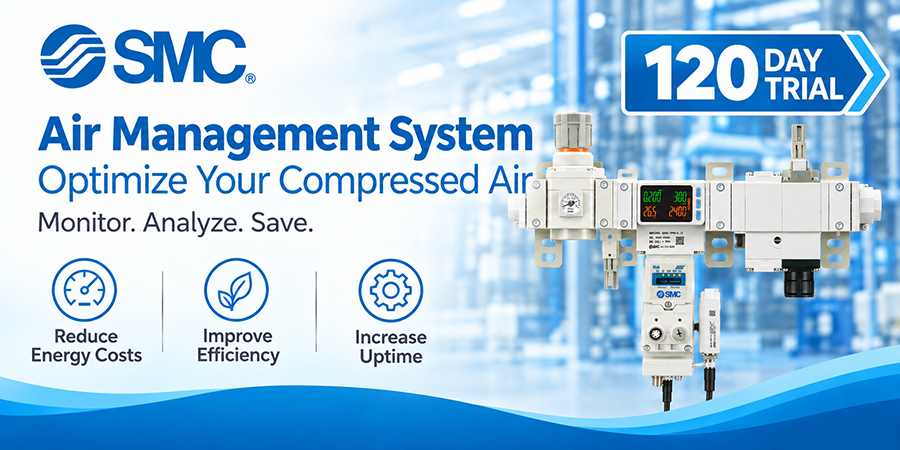
Test SMC’s Air Management System (AMS) in your factory for 120 days, for a nominal cost of $500, and see firsthand how easy it is to stop losing money to inefficient compressed air.
Your pneumatic system is a vital utility, but it's almost certainly your biggest consumer of energy; primarily due to unmanaged air leaks and maintaining air pressure levels even when machines are idle. These issues also reduce machine performance and result in a higher carbon footprint.
Our AMS detects standby conditions and automatically lowers pressure to reduce air waste. You can retrofit existing equipment with a direct OPC UA connection, without making PLC changes, and scale from 1 to 10 units using the SMC wireless system.
Why should I participate in the 120-day trial?
SMC's Air Management System reduces compressed air consumption by as much as 62%. It features wireless connectivity that reaches up to 100 meters, providing real-time data on pressure, flow rates, fluid temperature, and other key metrics, enabling you to proactively schedule maintenance and machine downtime.
What is included in the trial?
-
The complete Air Management System unit
-
On-site or remote setup support
-
Detailed machine analysis to find more air-saving opportunities
-
Standby electro-pneumatic regulator
-
Modular connection
What are the technical specifications?
The system is fully compatible with SMC wireless systems and eliminates the need for a communication cable between the base and remote units. A single base can connect to up to 10 remotes and supports OPC UA, IO-Link, EtherNet/IP, and EtherCAT industrial protocols.
Download the PDF Flyer
Compressed Air FAQs
What are air compressor monitoring systems?
Air compressor monitoring systems are integrated networks of hardware sensors and software dashboards designed to track, analyze, and manage industrial compressed air systems in real-time. The ongoing measurement of pressure, airflow, temperature, power consumption, and vibration allows facility managers to detect leaks and idle machinery and prevent system failures.
How are leaks detected and managed with air management systems?
Air management systems use intelligent sensors to detect leaks by continuously monitoring flow rates and pressure levels across a facility's pneumatic network. It establishes a baseline of normal air consumption during active production, so that the system's sensors can identify anomalies. When a leak is detected, the system manages the issue through a combination of automated controls and targeted maintenance alerts. The monitoring software also sends notifications and detailed analytics to maintenance teams, allowing them to measure the severity of the leak and pinpoint its location so that repairs can be made in a timely manner.
How does data acquisition and connectivity work in an AMS?
It operates through a network of integrated sensors that continuously capture real-time metrics directly from the pneumatic equipment. This granular data is transmitted to a central hub or base unit using wireless technology to eliminate cabling and bridge long distances between remote nodes. The system leverages standard industrial communication protocols like OPC UA, IO-Link, EtherNet/IP, or EtherCAT to feed the information into PLCs, edge servers, or cloud-based dashboards, allowing operators to monitor performance and trigger automated controls and maintenance alerts from a single digital interface.