
Pneumatic Linear Actuators
Basic linear air cylinders are used to provide straight-line, in/out linear movement for a variety of applications. Available as single acting (spring extend or spring return actuators) and double acting styles with single rod or double rod configurations, non-rotating, and precision non-rotating models.
Actuator body styles include crimped, round, or tie rod. Single acting air cylinders develop thrust in one direction and have spring return mechanism, which lowers air consumption compared with the equivalent size of double acting air cylinders. Using a double acting air cylinder, air pressure may be alternately applied to provide force in both directions.
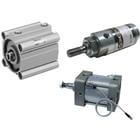

Standard Linear Actuators
Pneumatic linear actuators are the muscle of industrial automation. They are used by OEMs and automation engineers in the manufacturing, packaging, and food & beverage industries for repetitive, end-to-end material handling tasks like clamping, ejecting, and sorting. These actuators offer standardized premium features, a long cycle life with minimal maintenance, and easy customization. They deliver high force in a small footprint and are available in an industry-leading array of bore sizes, stroke lengths, and mounting configurations.

Stainless Steel Body
Stainless steel body actuators are designed for durability, and feature integrated auto-switch capabilities and crimped design end caps. The round stainless steel body is corrosion resistant, sheds water, and keeps bacteria from building up; making it ideal for sanitary environments and facilities subject to frequent washdowns. Stainless steel body actuators come with standardized premium internal components, such as bronze rod bushings and high-quality piston seals.

Round Body Repairable
Round body repairable actuators are built for rapid field repair and can be disassembled to replace worn-out internal seals and O-rings. The seal repair kits contain urethane or NBR seals, are readily available, and the clear specifications make the rebuild process quick and easy. Reparable actuators are preferred by facilities where downtime is expensive or where the actuator is subject to harsh, demanding conditions.

Tie Rod Linear Actuators
Tie rod linear motion actuators are the heavy duty workhorses of the automation world. They use steel rods to bolt the two square end caps against the actuator barrel and are procured by heavy industry because they can withstand high internal pressures and forceful external shock loads. They are repairable, include high-quality air cushions on both ends of the cylinder, and are manufactured with aluminum profiles and end caps to deliver a lighter unit that doesn't sacrifice strength.

Pin Linear Actuators
Pin linear motion actuators are among the most compact cylinders available on the market. They are miniature, lightweight cartridges designed to produce short, precise strokes. They’re used for circuit board assembly, chip sorting, pill sorting, and fine parts ejection. Because they are almost weightless, they are ideal for mounting on the end of high speed robot arms.

Pneumatic Compact Linear Actuators
Pneumatic compact linear actuators come in 15 bore sizes paired with standard off-the-shelf options like water resistant scrapers, dual rod configurations, non rotating rods, and end-of-stroke mechanical locks, eliminating long custom engineering lead times. They are engineered to deliver maximum thrust within a short overall axial length. They're up to 50% shorter than tie-rod or round-body models of equivalent bore size which conserves factory floor space. Compact actuators have shorter dead volume inside their chambers and consume less compressed air per cycle, improving cycle times while reducing compressor load.

Interchange Type
Interchange type actuators conform to standardized industrial dimensional envelopes, where mounting hole pitch, thread pitch, stroke length, and rod diameter are identical across standard manufacturers. They can be installed without re-drilling brackets, machining adapter plates, or re-coding position sensors and are usually sourced by facilities with legacy production lines, for global OEMs, and by systems retrofitters. They allow manufacturers to design a machine once using ISO or NFPA standards knowing that replacement actuators and seal kits can be sourced locally anywhere in the world, and mitigate supply chain risk at the same time.

Special Applications
Actuators for special applications are engineered to solve niche industrial challenges that standard air actuators can't, such as strict sanitary regulations, caustic environments, or sensitive motion profiles. These include 100% stainless steel actuators, actuators molded to eliminate surfaces where food particles, moisture, or bacteria could hide; and a sine actuator where the piston rod moves smoothly along a sine wave, replicating the motion of an electric actuator.

Locking Rod Actuators
Locking rod actuators hold their precise position during a loss of air supply. They enable manufacturers to meet ISO 13849-1 machine safety directives, OSHA drop prevention mandates, and CE emergency stop requirements, ensuring that if the power supply is interrupted, heavy payloads will not fall and damage equipment or injure operators.
Frequently Asked Questions
How does a linear actuator work?
A pneumatic linear actuator operates like a powered syringe, using compressed air pumped into a metal tube to push against a piston. As air pressure forces the piston forward, an attached metal rod extends out of the housing to move external loads. Reversing which side of the piston receives air (double acting), or releasing the pressure so an internal spring takes over (single acting), pulls the rod back, creating straight-line motion.
What’s the difference between dynamic load and holding load?
Dynamic load is the force an actuator can move from point A to point B; while holding load, also known as static load, is the force it can hold stationary when stopped – without drifting, backdriving, or collapsing.
How do limit switches function?
Limit switches route low-voltage signals to a PLC or motion controller. The PLC then slows the motor down, puts on the brakes, or triggers the next step in the process. As a built-in safety feature, the system is set up so that if a wire ever breaks or comes unplugged, the computer stops the machine immediately.
Which pneumatic linear actuators have a 100% duty cycle?
All standard pneumatic linear actuators have a 100% duty cycle. They can cycle back and forth 24 hours a day, 7 days a week, without stopping to cool down. However, that doesn't mean there aren't any restrictions.
- Running the cylinder at excessive speeds will degrade the seals
- Cylinders need internal air cushions or external shock absorbers
- Cylinders also need clean, dry, conditioned air