
The Smart Air Management Guide to Optimizing Compressed Air Systems
By deploying smart, connected devices at the machine level, plant operators can reduce artificial air demand during non-production periods, lower energy bills, and leverage high-resolution remote monitoring for predictive maintenance.
Why Compressed Air Systems Waste Energy (H2)
Pneumatic systems are integral to industrial automation and have good power density, low initial cost, and significant reliability. Their only major drawback is inefficiency. There are three primary causes for this.
- Idle Waste. Machines can spend 38% or more of their time in idle mode while still being kept at full air pressure. This is where the majority of leak waste happens.
- Pressure-Driven Air Leaks. The volume of air lost to leaks is proportional to system pressure. Maintaining maximum pressure during downtime inflates energy costs.
- Lack of Robust Leak Detection. Quantifying industrial air leaks manually requires planned downtime, specialized survey equipment, and skilled labor. Scheduling enough downtime on the machine to perform a leak survey is difficult since planned production always takes precedence.
Because of these inherent inefficiencies, compressed air is typically one of the most expensive forms of power transmission used in industry, so much so that it is often considered a “fourth utility”, and one that requires proper management to minimize the environmental impact.
“When you consider that just one 125 hp compressor consumes approximately $95,000 in electricity per year* it’s clear how much you can gain by improving your compressed air system efficiency. “ - Kaiser Compressor
There are many pneumatically driven actions on machines and involves the use of multiple pneumatic components. Compressed air consumption does not stop when production stops. Leaks, blowoffs, and machines waiting for product continue to use compressed air whether a product is successfully produced or not.
Calculating total financial and carbon impacts requires evaluating four baseline metrics:
- Compressor power consumption (kW/CFM)
- Compressed air energy costs ($/kWh)
- The CO2 emission factor (kgCO2/kWh)
- The annual hours of operation
The target for compressed air cost reduction is typically idle-mode air consumption, which includes the machine’s internal leakage, air used for blow-offs, and air used to cool electric motors and electrical cabinets. A modern Air Management System (AMS) achieves energy efficiency by introducing automated monitoring and active pressure regulation directly at the point of use.
How Air Management Systems Slash Energy Use
Lowering the baseline pressure dramatically cuts the financial impact of undetected leaks across the entire factory. An Air Management System intelligently monitors flow and pressure at the machine level. This continuous monitoring of KPIs can replace manual troubleshooting, alerting the facility to a system pressure issue before it becomes a total breakdown. A byproduct of monitoring the KPI’s of pneumatic system flow and pressure performance will result in improved reliability and convenience, allowing repair parts to be ordered in advance, and the leak repair scheduled when it’s convenient.
Additionally, the AMS features smart monitoring capabilities that stream high-resolution data directly to a facility's SCADA system. The end user can take full advantage of the monitoring to collect and analyze machine performance and establish condition based maintenance algorithms, thus minimizing breakdowns due to pneumatic component failure. Programmable parameters can automatically drop pressure to standby when the machine is idle for a defined period, and eventually shutting off and exhausting the air if the machine stays idle.
A 4-Step Framework for Factory-Wide Air Optimization
To scale compressed air efficiency across an entire plant, follow this four-step process:
- Baseline & Visualization. Measure real-time flow and pressure and identify the required operating pressures for each machine. Then determine which areas consume the highest amount of air flow rate in operation and what air consumption is required while in standby.
- Pressure Minimization. Eliminate supply-side bottlenecks to lower pressure across the factory floor and confirm machinery runs reliably at reduced target pressures.
- Leak Mitigation. Implement automated standby pressure reduction to minimize leak volume during short pauses and use real-time flow monitoring to trigger targeted repair work orders.
- Supply & Compressor Matching. Adjust central compressor output to reflect reduced demand. Then shut off unneeded high-pressure units and use adaptive controls to maintain optimized low pressure flow.
Air Management System Case Study
In 2022, SMC Corporation performed a six-month study at a key client’s facility, installing an Air Management System on a bottle-filling production line with 10 machines. The Air Management System evaluated was an assembly of components, consisting of the following:
- Electro-pneumatic pressure regulators
- Manual pressure regulators
- Multiple communications units (HUB):
- 2AMS base units
- 8 remote units
- Residual pressure relief valves
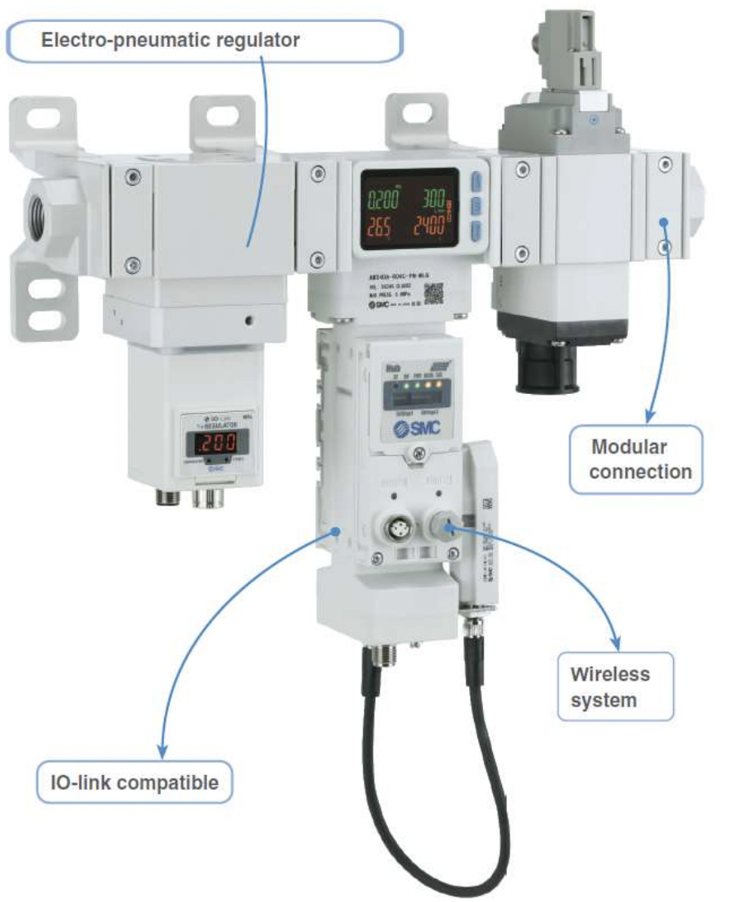
The AMS system was designed to easily and semi-automatically reduce or remove the compressed air supplied to an idle machine. The AMS base unit had an integrated server to facilitate data transfer. Data was stored in an internal buffer and published to the supervisory control system via the integral OPC UA client. It was simultaneously published to the machine’s controller using an industrial fieldbus protocol. The eight wireless remote units were paired with the AMS base units. This enabled a hybrid system wherein the PLC takes control of the real-time processes, and the data is communicated to the data cloud for analysis.
The AMS installed for the test was designed to replace the traditional filter/regulator unit for easy installation and maintenance. Its compact size took little additional space in the facility or on the machine, making it an attractive solution for users looking to improve their environmental and system performance without incurring significant installation costs.
Results & Impact
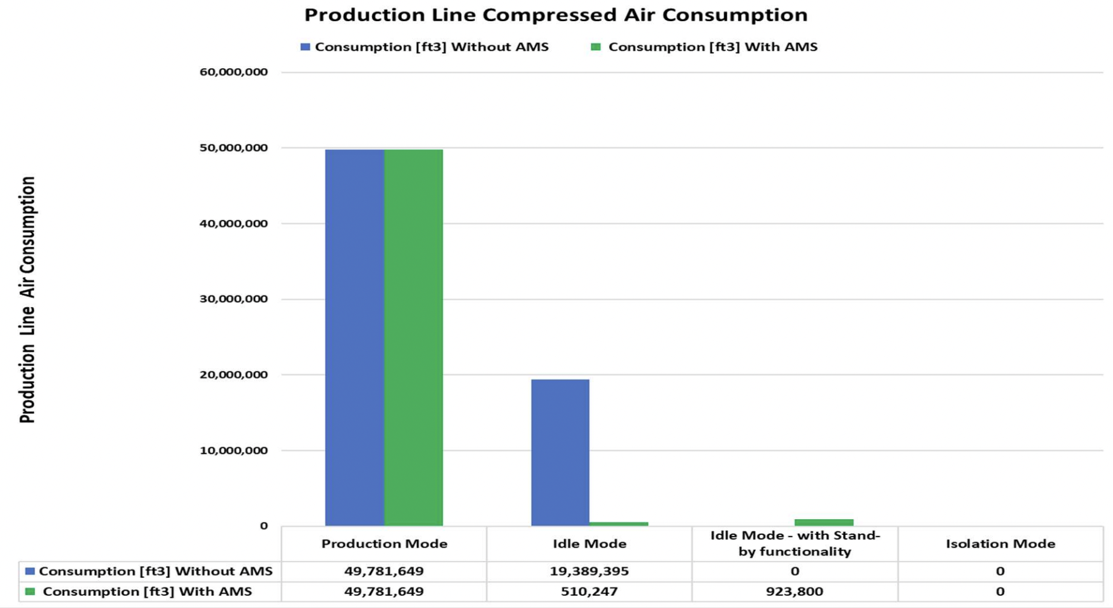
- Use of the Air Management System reduced artificial demand during idle periods, reducing energy expenditure by 25%–40%.
- Advanced compressor control utilizes a soft pressure ramp function to avoid sudden pneumatic jerks when restoring the compressed air supply to the machine.
- Flow Consumption by the machines in the production line can be converted to energy use and operational costs, and be correlated to production metrics, namely understanding the energy consumption per item produced, the cost of defective product, the cost per shift due to waste, and thereby optimize production processes.
- The high-resolution data provided by an AMS enables the benchmarking of machines and factories. Users can compare machines to learn from them and implement best practices companywide.
- The data generated by the AMS is high resolution, so fine details of a machine’s operation can be observed. With analytics software packages, high-resolution data can be used for leak detection, to predict pneumatic component failures, to build digital twins, and to understand the machine’s energy efficiency more deeply.
Continuously monitoring and optimizing compressed air transforms a costly utility into a predictable, digitized asset. By pairing automated machine controls with real-time analytics, facilities can reduce their carbon footprint, eliminate unplanned downtime, and extend the operating life of their equipment. Read the white paper.