
Electric Rotary Actuators With Table
Rotary electric actuators feature a rotating worktable positioned above an enclosure for the motor and drivetrain. Three different motor/table sizes are available, with each size offering a basic and high torque variation. Additionally, each size offers four rotating angle options, including 90°, 180°, 310 / 320°, and continuously rotating.
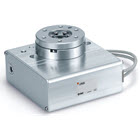
LER Rotary Table, Incremental Encoder
The incremental encoder version of the LER rotary table provides a cost-effective solution for precision positioning where a fixed reference (homing) at start-up is acceptable. Like other models in the series, it offers high-speed actuation of up to 420°/sec and high acceleration rates, making it suitable for rapid movement between stations. It uses a step motor to achieve up to 64 programmable positions with shock-less operation. This model is commonly used in general-purpose automation where the application follows a repetitive cycle and can easily perform a return-to-origin sequence upon each initial power-up.
LER Electric Actuator Rotary Table 360 Degree
This electric rotary table is engineered for applications requiring 360° continuous rotation, making it ideal for multi-process indexing or spinning operations. It features a built-in step motor (24 VDC) and a special worm gear design that ensures high output torque while maintaining low backlash. Its design includes a hollow shaft to facilitate the routing of wiring and piping for workpieces mounted directly on the table, enhancing its utility in complex robotic setups.
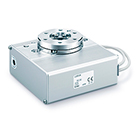
LER Rotary Table, Battery-less Absolute Encoder
The battery-less absolute encoder version of the LER series is designed to eliminate the need for homing routines after power loss. This model is particularly beneficial in safety-critical or high-uptime environments where restarting a machine from a known position saves significant time. It integrates seamlessly with PLC systems via fieldbus protocols or IO-Link, providing robust feedback for complex motion control.
Rotary Table FAQs
What is the maximum rotation angle for the LER series continuous rotation model?
The LER continuous rotation model is designed for a 360° rotation angle. However, the angle setting range can be configured up to +9,999,999.99° using relative operation.
What types of motor and control systems are used in this series?
These actuators use a 24 VDC step motor. They are compatible with the LECP6 series step data input type controller, which allows for 64-point positioning.
How does the high torque model compare to the basic model in terms of rotating torque?
The maximum rotating torque depends on the actuator size and type:
- Size 10: 0.22 N·m (Basic) vs. 0.32 N·m (High Torque).
- Size 30: 0.8 N·m (Basic) vs. 1.2 N·m (High Torque).
- Size 50: 6.6 N·m (Basic) vs. 10 N·m (High Torque).
What are the speed and acceleration capabilities of these rotary tables?
The actuators offer high-speed, shock-less actuation with a maximum speed of 420°/sec and a maximum acceleration/deceleration of 3,000°/sec².
What is the difference in deflection accuracy between the basic and high precision types?
- The high precision type significantly reduces table deflection:
- Basic Type: 0.1 mm deflection on the top and external surface.
- High Precision Type: 0.03 mm deflection on the top and external surface.
Can these rotary tables be used for clamping operations?
Yes, they support pushing operations for clamping or stopping against an external object. When using this mode, it is recommended to set the pushing start position at least 1° away from the workpiece to avoid alarms like Posn failed or Deviation overflow.
What should be done if the actuator needs to be operated without power?
The units are equipped with manual override screws on both sides of the body, allowing for manual rotation when not energized.
What factors must be considered during model selection?
Proper selection requires checking the moment of inertia, effective torque (based on load type), and allowable loads (radial, thrust, and moment). SMC provides specific graphs to confirm if the intended angular speed and acceleration are within the actuator's limits.
How does cable length affect the actuator's performance?
Speed and torque may decrease if the cable length exceeds 5 meters. Specifically, performance can decrease by up to 10% for every 5 meters of additional cable (e.g., a 20% reduction at 15 meters).