
Benchtop Chemical Chiller
The HED is a specialty recirculating chiller designed for direct temperature control of chemical liquids in the 300 to 900 watt capacity range. The device consists of a controller and separate fluororesin heat exchanger. An external circulation pump must be customer supplied. Typical compatible fluids include hydrofluoric and sulfuric acid, copper sulfate solution, ammonia hydrogen peroxide, sodium hydroxide, and deionized or ozonated water. A refrigerant-free, thermoelectric peltier element controls temperature from 10.0 to 60.0°C, with precision of ±0.1°C. Extracted heat can be removed via facility water connection. 17 failure diagnostics can be displayed on the LCD display or read out over serial communication.
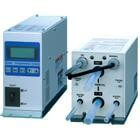
HED-W, Thermoelectric Chiller for Chemicals (Controller / Heat Exchanger Combination)
The HED-W is a recirculating water-cooled chiller system designed for direct temperature control of corrosive or high-purity chemicals. Unlike standard chillers, the HED-W runs the chemicals themselves through its fluororesin heat exchanger. It is used in semiconductor and microelectronics manufacturing, chemical and pharmaceutical R&D, and analytical instrumentation where chemicals must stay at a precise temperature to prevent side reactions or degradation. The compact, benchtop size and lack of a noisy compressor make it suitable for indoor environments where space and silence are at a premium.
- Cooling capacity: 300 W, 500 W, 750 W, 900 W
- Temperature range setting: 10 to 60°C
- Temperature stability: ±0.1°C
- Power supply requirement: single phase 180 ~ 242 VAC, 50/60Hz
- Circulating fluid: Various liquid chemicals, see catalog (fluororesin compatible)
- Standards: Ce, SEMI S2-0706, F47-0706, RoHS
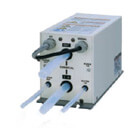
HED-H, Liquid Chemical Heat Exchanger
The HED-H is the heat exchanger component of the HED-W thermoelectric chiller for chemicals. Because it contains the sections that touch the chemicals, it is the component most likely to fail or wear out over time. If the controller (HED-C) is still working, it is most cost effective to simply replace the HED-H. Other times, a company may be using its own PLC or a custom-built control system to manage the power and only need the HED-H because it provides the physical interface without the extra bulk of the SMC controller.
- Circulating fluid pump must be provided by customer
- Device includes peltier element, sensors, and flow paths for circulating fluid and facility water
- Choose from two PFA tube sizes for circulating chemical fluid
- Flow paths, signal and DC connectors, and purge ports located at front
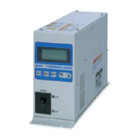
HED-C, Controller for Thermoelectric Chiller
The HED-C is the controller component of the HED-W thermoelectric chiller system. While the HED-H handles the heavy lifting of removing heat, the HED-C is the digital control interface and power supply. The HED-C contains the DC power supply and the control board, the parts most vulnerable to electrical surges or simple end-of-life component failure. The HED-C is often purchased as a spare part to minimize downtime. It’s also purchased to integrate the chemical cooling process into a larger factory automation system or when a facility wants a modular set-up.
- Fan cooled internal power supply
- Front panel includes display and input panel, and power switch
- Connectors for heat exchanger, alarm output, communication, and power located at rear
- Compatible with RS-485 or RS-232C
Industrial Applications
The HED-W is designed for the following industrial processes and applications:
-
Plating Equipment: Applied in systems that require consistent chemical temperatures for electroplating or chemical plating processes.
-
Wet Etching Equipment: Used to manage the temperature of acids or other chemicals during the etching process in semiconductor or display manufacturing.
-
Semiconductor Manufacturing: The unit is designed to handle high-purity chemicals and deionized water common in semiconductor fabrication.
-
Chemicals: It is used to manage the temperature of various chemicals, including hydrofluoric acid, ammonia hydrogen peroxide solution, sulfuric acid, sodium hydroxide, and ozone water.
Core Functionality and Design
-
Direct Control: Unlike indirect systems, the HED series allows chemical liquids to flow directly through a fluororesin (PFA) heat exchanger, eliminating the need for separate tube-type exchangers and reducing the risk of metal ion contamination.
-
Peltier Technology: The chiller uses solid-state Peltier elements (thermo-modules) for its heating and cooling system, enabling high-speed switching and precise temperature stability of ±0.1°C.
-
Inert Wetted Parts: All parts in contact with the fluid are made of PFA (fluororesin), making it compatible with aggressive chemicals like hydrofluoric acid, sulfuric acid, and ammonia hydrogen peroxide.
System Components
The system is typically comprised of two main units, which can be purchased together as a set (HED-W) or individually:
-
HED-H: The physical unit where the chemical is cooled or heated using facility water to radiate waste heat.
-
HED-C: The digital interface that regulates the DC power supply to the heat exchanger based on sensor feedback to maintain the target temperature.
Key Specifications
|
Specification |
Details |
|
Cooling Capacity (Water) |
300 W, 500 W, 750 W, or 900 W |
|
Heating Capacity (Water) |
600 W to 2300 W (depending on model) |
|
Temperature Stability |
±0.1°C (with stable load) |
|
Set Temperature Range |
10.0 to 60.0°C |
|
Wetted Parts Material |
Fluororesin (PFA) |
|
Circulating Fluid Pressure |
0 to 0.35 MPa (up to 0.5 MPa for HED009 at <50°C) |
|
Control Method |
Peltier-type PID control (Cooling/Heating auto-shift) |
|
Facility Water Flow Rate |
5 to 10 L/min |
|
Facility Water Temperature |
10 to 35°C (no condensation) |
|
Communication Protocols |
RS-485 or RS-232C |
|
Power Supply |
Single-phase 180 to 242 VAC, 50/60 Hz |
|
Safety Features |
Leakage sensor (standard), upper/lower limit alarms, output shutdown |
Benchtop Chemical Chiller FAQs
What is the SMC HED Series?
It is a Peltier-type temperature control system designed for direct temperature control of chemical liquids (like those used in wet etching, plating, or cleaning equipment).
Does the system use refrigerants?
No, it is a refrigerant-free system, making it more environmentally friendly than compressor-based chillers.
How does the Peltier device work?
The Peltier device is a solid-state element that removes heat from one when DC current is applied. By reversing the current direction, the device can switch between heating and cooling rapidly for precise control.
What safety features are built into the device?
The unit includes a leakage detection sensor as standard to safely detect any leaks of the circulating fluid. It also features alarm outputs and communication ports.