
Circulating Bath
The HEB is a thermoelectric circulating bath comprised of a controller and liquid tank. Cooling is performed by a refrigerant-free peltier element, with extracted heat removed via facility water connection. Temperature can be set from -15.0 to 60.0°C (flourinated fluid), achieving a distribution of ±0.2°C in the bath. Abnormal heating and temperature sensor errors can be detected and reported. Overall dimensions and power requirements are suitable for laboratory benchtop service.
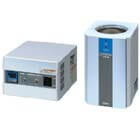
HEB-W, Peltier-Type Thermoelectric Bath (Controller / Tank Combination)
The HEB-W is a thermoelectric circulating bath with a controller and liquid tank. Because it uses Peltier elements rather than a traditional compressor, it’s quiet, vibration-free, and compact. It’s favored in the biotech and chemistry industries for its tight temperature stability, where it’s used for reagent and analytical instrument cooling. It’s also used by tech engineers to maintain a constant temperature for wafers or electronic components during stress testing. Manufacturing QC departments use the HEB-W to ensure that digital thermometers and thermal probes are accurate by immersing them in a perfectly temperature-stabilized fluid.

HEB-H, Liquid Tank for Thermoelectric Bath
The HEB-H is sold as a liquid tank replacement for the HEB-W thermoelectric circulating bath. The tank is the part most likely to wear out after years of 24/7 operation, and is often purchased to replace a failing chiller unit without having to reinstall a working HEB-C controller. It’s also used when a lab wants to customize the cabling and physical layout of their workstation by placing the tank and the controller in separate locations or when a manufacturer needs the thermal management hardware to be controlled by their software or PLC system.

HEB-C, Controller for Thermoelectric Bath
The HEB-C is sold as a replacement controller for the HEB-W thermoelectric circulating bath. There are three common situations for the controller to be purchased. First, in industrial environments, the controller is the part most exposed to human interaction and electrical fluctuations. It will need to be replaced if there is interface failure, problems with the communication ports, or damage to the internal circuitry of the controller. Second, in a laboratory, researchers may want to replace an older, manual setup with a fully automated one where the temperature is adjusted dynamically based on a software script. Third, in situations where downtime is expensive, a controller might be purchased to have on hand as a spare part.
In a thermoelectric circulating bath, the controller acts as the brain, the tank acts as the body and they are linked in a continuous feedback loop to maintain a perfect temperature. The HEB-C is the command center and its primary functions are as a user interface, for PID control, and safety monitoring. The HEB-H is where work happens. It contains the Peltier elements and executes thermal exchange, is responsible for fluid circulation, and houses the temperature sensor that sends data back to the controller.
The controller and tank of the HEB-W circulating water bath are a closed loop system.
-
The controller is told to keep the water at exactly 25.00°C.
-
The tank measures the current water temperature (24.85°C) and sends this signal to the controller.
-
The controller realizes the water is 0.15°C too cold. It calculates the specific voltage needed to warm it up.
-
The controller sends DC power to the Peltier elements in the tank to generate heat.
-
The tank’s pump ensures the warmed water is mixed thoroughly and pushed out to the application so the temperature is uniform throughout.
-
This cycle happens many times per second, allowing the system to maintain a stable 25.00°C.
Circulating Bath FAQs
What are the primary differences between this product and other SMC chillers?
-
A heated circulating bath is primarily targeted toward life sciences applications. Items whose temperatures need to be regulated are directly immersed into an open bath. This is different from recirculating chillers, which connect to a heat source through fittings and hoses, creating a closed coolant circuit flowing through heat exchangers. The circulating water bath has a physical size limit, which is the shape and volume of the bath. The bath has a cooling capacity limit as well. Typically this would be for chemicals in test tubes or small parts.
-
Another noteworthy difference is that the HEB series bath uses a Peltier thermoelectric device instead of refrigerant, with its hot side requiring facility water to cool it. There is no fan cooled version.
-
Finally, the HEB consists of two physically separate components – the controller and the bath.
What are the advantages of a circulating water bath?
-
Smaller items, and anything that can be confined to an immersible container or circuit or loop (including gases) can be cooled.
-
Items can be immersed and removed as required since the bath is open and exposed.
-
Refrigerant free
-
Small size suitable for a tabletop can be easily integrated into most lab setups
-
Flexible power supply from 100~240VAC, 50/60Hz
Under what circumstances is a circulating bath preferable or required (applications)?
-
When the item to cool is small, rather than a larger piece of equipment
-
When the item to cool is moveable, such that it can be immersed and removed as needed, rather than a stationary piece of laboratory equipment
-
Non-traditional materials such as liquids and gases, assuming they are contained in flasks, beakers, test tubes, or circulated through closed metal tubing
-
When only a small cooling capacity is required
What are the key components of a circulating bath?
-
The controller and the bath
-
Facility water connections
-
The internal Peltier cooling element
-
User-supplied recirculating liquid