
Electric Grippers
SMC electric gripper series includes three series (LEHZ, LEHZJ and LEHF) fitted with two fingers. LEHS is available with three fingers. Dust covers, low profile fingers and long stroke options are some of the series options. The 3 finger type is ideal for holding round work pieces. Benefits of electric grippers include adjustable gripping forces, a drop prevention function, and capability for recognizing different dimensions and outputting length measurements.
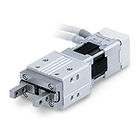
LEH 2 Finger Electric Grippers
The LEH family of electric grippers includes three series fitted with two fingers. These grippers offer high-precision control with adjustable gripping forces, a drop prevention function to secure workpieces during power failures, and integrated encoders for gauging and dimension recognition.
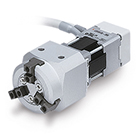
LEHS, Electric Gripper, 3-Finger
The LEHS series is a 3-finger electric gripper specifically engineered for handling cylindrical, spherical, or easily deformed workpieces that require centered gripping. Its three-finger design ensures high stability and repeatable positioning, making it an ideal solution for specialized pick-and-place tasks where standard two-finger grippers may lack the necessary contact area.
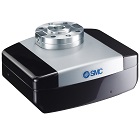
LEHR, Electric Gripper for Collaborative Robots
The LEHR is a specialized electric gripper designed for collaborative robot (cobot) environments, featuring a universal mounting interface and plug-and-play software compatibility with major brands like Universal Robots, FANUC, and Omron Techman. It is engineered for human safety with rounded edges and corners to minimize collision risks, and it utilizes a single-cable M8 connector for streamlined installation.
A self-locking mechanism prevents drops after power loss, while saving energy during gripping and standby.
Answers to Commonly Asked Electric Gripper Questions
What is an electric gripper?
It is an advanced motion control system used to grasp, hold, and release objects. Unlike pneumatic grippers that rely on compressed air, electrically powered grippers use electric stepper or servo motors to control the movement of its fingers.
How does an electric gripper work?
Its control system uses sensors to monitor its position and the force applied by its jaw grippers. Because the motor is electronically controlled, it can be programmed for the exact parameters the process requires. The motor generates rotational force, which is converted into linear or angular movement with a motor system such as a slide screw or belt-driven slide shaft for maximum reliability.
What is the difference between electric and pneumatic grippers?
The difference lies in their power source and level of control. While pneumatic grippers rely on compressed air for raw force and fast cycles, electrics use motorized actuators for high precision and adaptability.
Gripper Comparison
|
Electric |
Pneumatic |
|
Precise control over jaw position, travel speed, and gripping force |
Binary operation - either fully open or fully closed |
|
Lower force-to-weight ratio and require larger, heavier motors to get high gripping force |
Delivers substantial gripping forces from a compact, lightweight body |
|
Higher upfront cost per gripper, but only require standard electrical cabling |
While the grippers themselves are inexpensive, they require an expensive factory infrastructure |
|
Don’t emit exhaust air or risk leaking lubricating oil |
The seals will eventually wear out, leading to air leaks that waste energy. |
What are the electric gripper’s advantages and disadvantages?
- Precise force and position control. The distance the fingers open and the amount of force applied can be precisely and accurately programmed to safely handle delicate objects like glassware, electronics, or eggs and objects with very small parts.
- Real-time feedback. The finger grippers can detect if a part has been dropped or measure the width of an object to verify if it is the correct part and communicate this data back to the controller.
- Cleaner operation. Because they don't require compressors or air lines, there isn't a risk of air leaks, making them ideal for cleanrooms, medical device manufacturing, and pharmaceutical applications.
- Multi-position capability. Unlike pneumatic grippers that are either fully open or fully closed, their electric counterparts can stop at multiple intermediate positions, making them suitable for both delicate objects and heavy payloads and allowing them to handle a wide variety of part sizes in a single run.
While they carry a higher upfront cost and have a lower power-to-weight ratio than a pneumatic, their flexibility and intelligence make them the standard choice for smart manufacturing, collaborative robots (cobots), and high-mix, low-volume assembly lines.
What is their role in manufacturing automation?
Electrically powered grippers have revolutionized robotic end-of-arm tooling. They allow robotic systems to shift from single-purpose automation to flexible, data-driven production that enables factories to handle a diverse mix of products on a single line without stopping for mechanical retooling.
A good example can be seen in the automotive industry. Modern plants often run sedans, SUVs, and electric vehicles sequentially. Electric grippers allow a single machine tending robot to adjust its jaw stroke and gripping force as it works, eliminating the downtime required to change physical grippers. Additionally, when the grippers pick up a fuel injector or a transmission gear, they can measure the component's width using their integrated motor encoders. If the part is out of specification by even a fraction of a millimeter, the factory control system is alerted, flagging the part for rejection before it is permanently installed in the vehicle.
How do they work with cobots?
Traditional industrial machine tending robots require complex engineering to integrate pneumatic plumbing and heavy physical wiring. However, instead of routing heavy cables down the entire robot arm, most modern electric grippers plug directly into the tool connector port located right on the cobot’s wrist which simplifies installation and maintenance. By continuously monitoring the electrical current drawn by the gripper’s motor (which is directly proportional to torque and force), the controller knows exactly how much force is being generated. If a human finger gets in the way, the motor instantly detects the resistance, stops, and backs off before exceeding collaborative safety limits.
For CAD downloads, please visit individual product pages.