
Pneumatic Actuators
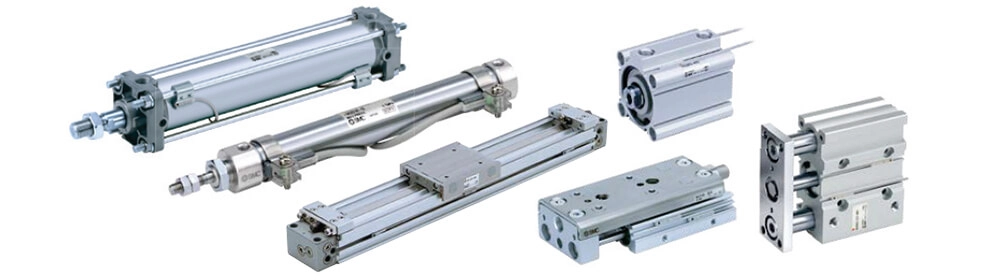
Pneumatic actuators provide fast, reliable motion control for a wide range of industrial automation and factory automation applications. Using compressed air to generate precise linear or rotary motion, these actuators deliver a durable, cost-effective solution for applications requiring high cycle rates, repeatable positioning, and consistent force output. Commonly used in material handling, packaging equipment, assembly systems, machine automation, and process control applications, pneumatic actuators support efficient and dependable operation across demanding industrial environments.
Engineered for versatility and seamless system integration, pneumatic actuator solutions are available in multiple configurations including compact cylinders, guided actuators, rodless cylinders, rotary actuators, and NFPA/ISO interchangeable designs. Robust construction, long service life, and low maintenance requirements help improve equipment reliability, reduce downtime, and support condition-based maintenance initiatives. Whether optimizing existing automation equipment or designing new pneumatic systems, pneumatic actuators provide the performance, flexibility, and operational efficiency required for modern industrial motion control applications.
Pneumatic Linear Actuators
Linear cylinders convert pneumatic energy into straight-line motion and are widely used across automation systems. Selection depends on control requirements and load behavior.
- Single-acting cylinders: Air pressure drives motion in one direction with spring or external return
- Double-acting cylinders: Controlled air supply enables force in both extension and retraction strokes
Pneumatic Guided Actuators
Guided cylinders are designed for applications requiring higher precision and resistance to external loads or side forces.
- Rod-guided cylinders: Compact design with integrated guidance for improved rigidity and accuracy
- Slide tables: Space-efficient actuators optimized for precise, smooth linear positioning
Pneumatic Grippers For Pick And Place
Grippers enable secure handling of workpieces in pick-and-place and assembly operations. Selection is typically driven by part geometry and handling requirements.
- Parallel grippers: Ideal for flat, parallel surfaces and standard component handling
- Angular grippers: Suitable for contoured or irregular shapes requiring opening rotation
- Concentric grippers: Best for cylindrical or spherical components requiring centered gripping force
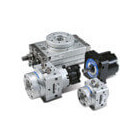
Pneumatic Rotary Actuators
Rotary cylinders convert compressed air into controlled rotational movement for indexing, turning, and positioning applications.
- Rack and pinion actuators: High torque output and durable mechanical design
- Vane-type actuators: Compact construction with smooth rotary motion characteristics
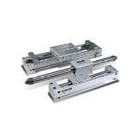
Pneumatic Rodless Actuators
Rodless cylinders differ from a basic air cylinder in that no piston rod extends outside the cylinder body. Instead, the internal piston is connected to an external carriage, by means of a magnetic or mechanical coupling system.
SMC's rodless cylinders are ideal for long stroke applications because they are unaffected by rod overhang, bending, piston binding, and uneven seal wear, and for use in confined areas where space is a premium.
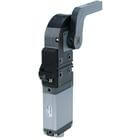
Clamps Pneumatic Operated
Pneumatic clamp cylinders are used for holding a workpiece in place while work is being done. Most pneumatic clamp cylinders are designed for weld spatter resistance for long life.
Pneumatic Specialty Actuators
When standard actuators aren't enough, specialized pneumatic actuators provide the performance, durability, and precision required for demanding operating environments. Designed for unique motion control challenges, these actuators are engineered to meet the needs of industries where extreme temperatures, corrosive media, high-cycle operation, limited installation space, or stringent regulatory requirements are critical factors.
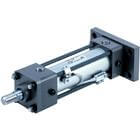
Hydraulic Equipment
Hydraulic actuators deliver powerful, precise linear or rotary motion for demanding industrial applications where high force and reliable performance are essential. Using pressurized hydraulic fluid to generate movement, these actuators are ideal for heavy-duty automation, manufacturing, material handling, construction equipment, mining, marine systems, and process control.
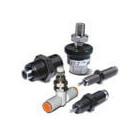
Pneumatic Actuator Accessories
Maximize the performance, reliability, and functionality of your actuator systems with our complete selection of actuator accessories. Designed to enhance pneumatic and electric actuators, these components help improve control, simplify installation, and extend equipment life across a wide range of industrial applications.
Our actuator accessories include position indicators, limit switches, mounting hardware, positioners, feedback devices, and repair kits. Each accessory is engineered for compatibility with leading actuator models and built to withstand demanding operating environments.
Common Pneumatic Cylinder Applications in Manufacturing and Automation
Pneumatic cylinders are used across a wide range of automation processes, including:
- Pressing and forming operations
- Lifting and positioning systems
- Transferring and conveying tasks
- Clamping and fixturing
- Stopping and indexing mechanisms
- Pick-and-place automation
- Sorting and material handling
Key Pneumatic Cylinder Sizing and Selection Criteria
Effective actuator selection requires evaluating both performance and environmental conditions to ensure system stability and longevity.
Bore Size and Force Requirements
Cylinder bore size directly determines the force available at a given operating pressure. Proper sizing ensures sufficient force to move the load while maintaining efficient air consumption and consistent machine performance.
Cushioning and Impact Load Management
End-of-stroke cushioning helps absorb kinetic energy and reduce mechanical shock during operation. Proper cushioning selection is especially important in high-speed applications and systems with heavy loads or high inertia.
Side Loads, Bending Forces, and External Loads
External forces can significantly affect actuator performance and service life. Applications involving side loading, bending moments, or misalignment may require guided cylinders or additional support mechanisms to maintain accuracy and reliability.
Air Consumption and Flow Rate Considerations
Airflow requirements influence actuator speed, cycle time, and overall pneumatic system efficiency. Evaluating air consumption helps optimize compressor capacity, reduce energy usage, and ensure adequate system performance.
Rotary Torque and Moment of Inertia Analysis
Rotary actuators must be sized to accommodate both torque requirements and load inertia. Proper analysis helps prevent overshoot, excessive wear, and motion control instability while improving positioning accuracy.
Environmental and Operating Conditions
Temperature, moisture, contamination, washdown requirements, and exposure to chemicals or particulates can impact actuator reliability and lifespan. Selecting products designed for the operating environment helps improve performance, reduce maintenance requirements, and support long-term system stability.
System Performance and Air Quality Considerations
Pneumatic performance is strongly influenced by compressed air quality. Contamination control, moisture management, and proper air preparation help prevent premature wear, improve actuator response, and maintain consistent system operation over time. Optimized air quality directly supports predictive maintenance strategies and reduces unplanned production interruptions.
Engineering Support and Configuration Tools
Proper actuator selection is supported through engineering tools such as configurators and sizing calculators that help define optimal cylinder type, bore size, and configuration based on application requirements. Combined with system-level design guidance, these tools support improved energy efficiency, reduced lifecycle cost, and more reliable automation performance across industrial applications.
Frequently Asked Questions – Pneumatic Actuators
1. How do I determine the correct bore size and stroke for a pneumatic cylinder in my application?
Selecting the correct bore size depends on the required force output, operating air pressure, and load conditions. Engineers should first calculate the theoretical force requirement (including safety factors for friction and dynamic loads), then match it to available system pressure. Stroke length is determined by the full mechanical travel required in the application, with additional consideration for cushioning, end-of-stroke clearance, and mounting configuration to ensure reliable operation without mechanical stress or over-extension.
2. When should I choose a guided cylinder instead of a standard linear actuator?
Guided cylinders should be used when the application involves side loads, off-center forces, or a need for higher positional stability. Unlike standard cylinders, guided actuators incorporate mechanical guidance to prevent rod deflection and premature seal wear. Applications such as press-fit operations, part alignment, or tooling motion—where precision and load stability are critical—benefit from guided designs that maintain alignment under dynamic conditions.
3. What role does cushioning play in actuator performance and system longevity?
Cushioning is essential in high-speed or high-inertia applications where abrupt stopping can cause mechanical shock, vibration, or damage to both the actuator and the machine structure. Properly adjusted pneumatic cushioning absorbs kinetic energy at the end of stroke, improving cycle smoothness, reducing noise, and extending service life. In applications with variable loads or cycle rates, adjustable cushioning provides flexibility to fine-tune performance without redesigning the system.
4. How does compressed air quality impact pneumatic actuator reliability and performance?
Air quality has a direct impact on actuator life, response consistency, and maintenance intervals. Contaminants such as moisture, oil, and particulates can degrade seals, increase friction, and cause inconsistent motion behavior. Proper air preparation—filtration, regulation, and drying—helps maintain stable performance, improves repeatability, and reduces unplanned downtime. In high-cycle environments, maintaining consistent air quality is critical for predictable actuator performance.
Advanced Technical FAQs
5. How do rotary actuators differ in selection compared to linear cylinders?
Rotary actuators are selected based on torque requirements, rotational angle, and moment of inertia rather than linear force and stroke. Engineers must consider load inertia, speed of rotation, and end-position control accuracy when sizing a rotary system. Rack-and-pinion designs are typically used for higher torque applications, while vane-type actuators are preferred for compact installations requiring smooth, controlled rotation. Proper sizing ensures accurate positioning and prevents overshoot or mechanical stress.
6. How do side loads and moment forces affect pneumatic cylinder life, and how can they be mitigated in design?
Side loads and moment forces are among the most common causes of premature wear in pneumatic cylinders. When a load is applied off-axis, it creates uneven force distribution on the piston rod, rod bushing, and seals, leading to increased friction, scoring, and potential seal failure. Over time, this can significantly reduce actuator life and repeatability. To mitigate these effects, engineers should either minimize external moment loads through mechanical design or select guided cylinders that incorporate linear bearings or external guide rods to absorb and distribute side forces independently of the main cylinder rod.
7. What is the impact of air consumption and flow capacity on actuator cycle speed and system efficiency?
Air consumption and flow capacity directly influence both actuator speed and overall system efficiency. Cylinder speed is governed by the rate at which compressed air can fill and exhaust the chamber volume, meaning undersized valves, tubing, or supply lines can create bottlenecks regardless of actuator capability. Excessive air consumption also increases compressor load and energy costs. Engineers should evaluate Cv or flow coefficient ratings of valves, optimize tubing lengths and diameters, and match actuator volume requirements to ensure balanced performance between speed, efficiency, and energy usage.
8. How should moment of inertia be evaluated when sizing rotary pneumatic actuators for dynamic motion control?
Moment of inertia is critical in rotary actuator applications where the load is not only about torque but also about acceleration and deceleration characteristics. High inertia loads require greater torque to achieve controlled motion without overshoot or oscillation at end positions. Engineers must calculate total system inertia, including attached tooling and workpieces, and match it against actuator torque curves across operating pressure ranges. Proper sizing ensures stable motion control, reduces impact at end stops, and improves positioning repeatability in indexing and transfer applications.